Editor’s Note: A PDF copy of the article is attached at the bottom of the page. Enjoy!
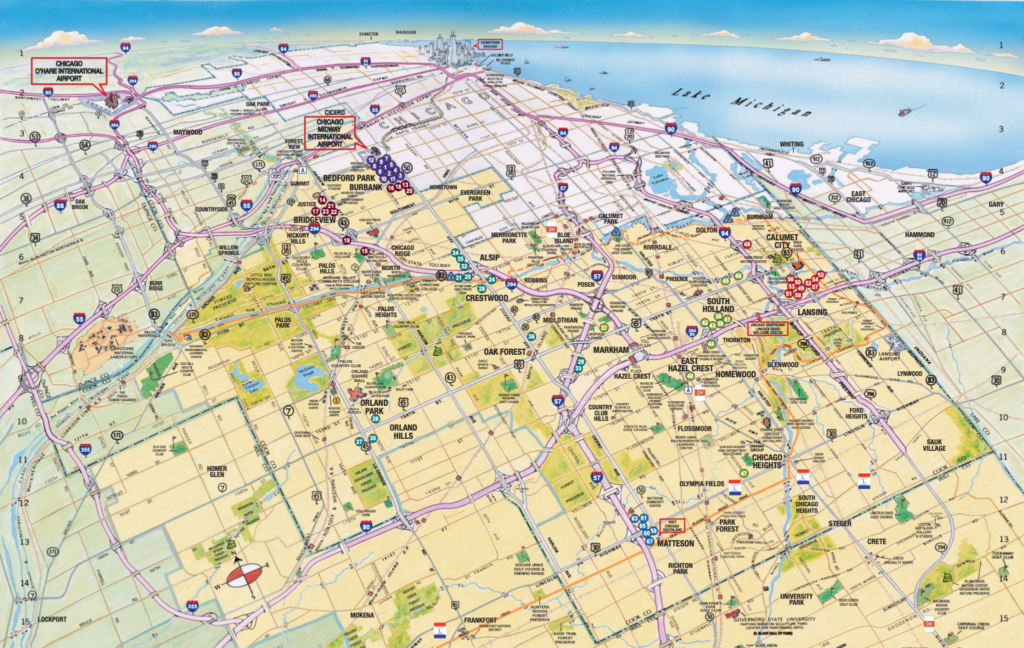
As communists, we naturally concern ourselves with the movement, settlement, and overall conditions of the working classes. Problematically as much of our theory stems from late 19th and early 20th century literature, the way we conceive of both the proletariat and of revolution recalls the formation of the proletariat in those times. Thus, many of our comrades, including ourselves at various points, have often posited-or subconsciously maintained-the inner city as the ultimate contradiction, the home of the proletariat which will bubble over and produce those first gasps of communisation. Yet it has long been understood that American cities have hollowed themselves out over the last 50 years, proletarians being pushed out to settle elsewhere.1 Over a decade ago, beloved Jacobin was able to characterize this mass shift, stating the following:
“The class geography of US cities has traditionally been the inverse of European ones. In the US, the rich took to the suburbs, leaving workers to occupy urban centers”. “In the last three decades, however, the bourgeoisie has returned to claim the city as its home”. 2
While the Jacobin/soft Marxist foray is a welcome introduction to the geography of class and herald what at that point was a 30+ year trend, it does little to break away from those most seditious tropes of our Marxists today: To reach communism, we have to organize better, and to organize better, we have to join an organization. This formula as described in the article arrives at the clawing back of the inner city, where bourgeois speculation has reached medieval stupor on the East and West coasts while quickly moving in on the Midwest and Rust Belt. Yes, the inner city must be defended, despite the utter failure of varying “anti-gentrification” and “affordability” movements which address too little, too late. We are not interested in social questions, demographics or class composition, we are interested in always being everywhere, organizing everything to produce organization which further organizes itself. These folks are allowed to hedge their bets on the Mamdani-esque Botox treatments cities across the nation are expected to undergo; We acknowledge the total prestige of the inner city as a battle that has long been lost.
Instead of an emphasis on social-democratic piecemeal strategies to sustain dwindling proletarian communities, we are interested in the social antagonisms that form in the proletarian city outskirts and suburbs, what anti-political character they take, how they relate to wage labor, and therefore illuminate what difficulties obstruct potentials for communisation and the abolition of capitalism.
This article, divided between sections on the earlier inner city, municipal outskirts, and existential dread of the modern suburban proletariat, seeks to contextualize this half century demographic shift in the context of Chicago’s nascent “Red Banlieues”, or housing projects and proletarian vestiges on the outer rings of the city, as well as the first ring of suburbs. A supplementary analysis is conducted on the social life of the proletariat, social formations which pose threats to the project of communisation, and how proletarian self-abolition may be conceived in these regions.
A Brief History of Chicago’s Tenements, Projects, & Urban Poor
To understand the site, condition, and attitudes of the proletariat today, we have to take a brief historical impasse, where concentrated industrial production dictated the settlement of proletarians. In the late 19th century, Chicago’s industrial production was relatively decentralized. This sprawl, characterized by employment centers such as the “Stockyards [Southwest] and the steel mills [Far Southeast] meant that low-income housing districts [in Chicago] were scattered, not concentrated as in lower Manhattan.”3 Unlike the 6, 7, or 8 story high rises of New York City, “Growing numbers of immigrant wage laborers crowded into the 2- and 3-story wood frame or brick buildings that lined dusty, unpaved streets within walking distance of the factories west of the Chicago River and surrounding the slaughterhouses just south of the city limits.”4 Many proletarian and immigrant families lived in shanty “rear houses” on the same property, in order to maximize rent.5
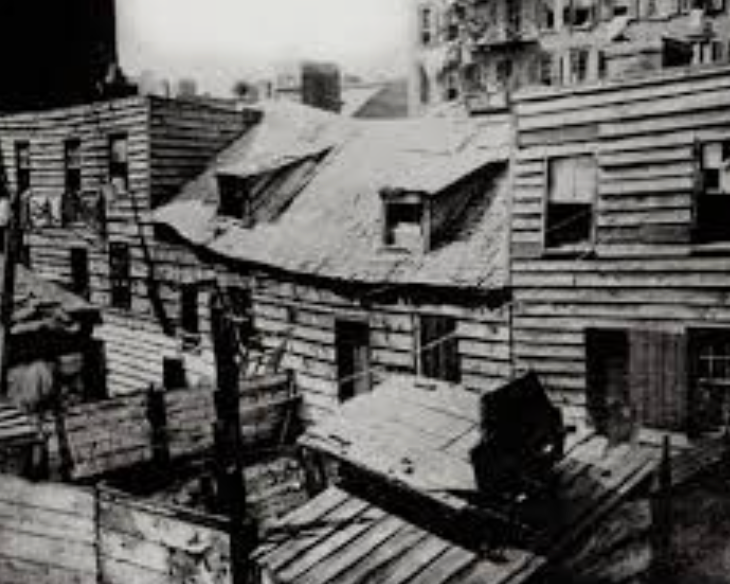
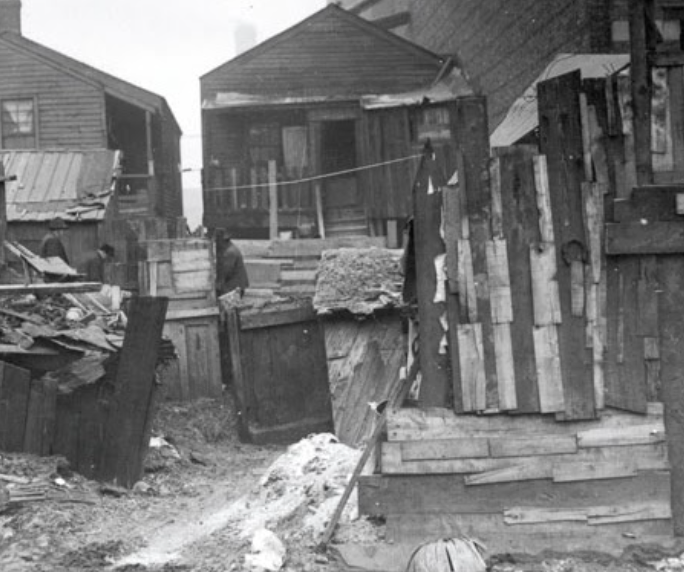
These dispersed tenements, of course, would not last forever. The city went through a wave of bourgeois reforms in the early 20th century to address sanitation, access to water, eventually culminating in the destruction of tenement housing and the advent of privately subsidized housing. The first projects, the Marshall Field Garden Apartments, came to the inner-city Near North Side and featured 628 units across 10 5-story buildings.6 Although these projects marked a turning point in early urban renewal and the lives of thousands, they ultimately failed to produce low-income housing. Rising costs to both the demolition of pre-existing tenements and the construction of the Garden Apartments saw prices spike, ultimately incentivizing sponsors Julius Rosenwald and the Marshall Field Family to raise rents and target upper semi-proletarians with surplus income. As years passed by and capitalists proved unreliable in solving the tenement crisis, the federal Housing Act of 1937 gave birth to our very own Chicago Housing Authority.
With it came a slate of subsidized public housing agglomerations, thought roughly as decentralized from each other: “Three projects were opened in 1938: Jane Addams Houses on the Near West Side, comprising 32 buildings for 1,027 families; Julia C. Lathrop Homes on the North Side for 925 families; and Trumbull Park Homes on the far South Side for 426 families.” “A fourth project, Ida B. Wells Homes, in the ghetto, was for blacks. Far larger than the other projects, it housed 1,662 families”.7
As more rails, mills, and factories advanced production towards the middle of the 20th century, the sprawl of Chicago’s public housing continued, just with new targets in its vision. While in the 1930s each project was segregated for the race of its site neighborhood in efforts to protect “local culture”, dubbed the “Neighborhood Composition Rule”, CHA embarked on a post-war policy of building public housing almost exclusively in more inner-city, Black neighborhoods. This essentially maintained the Neighborhood Composition Rule well into the 50s and 60s. What resulted was the construction of several infamous and white-supremacist abominations, including the “State Street Corridor”. Stretching from roughly 39th to 54th Street or 2 miles proper, Robert Taylor Homes, Harold L. Ickes, and Stateway Gardens comprised over 7,000 units of housing on the Black South Side.8 It was these massive housing complexes which subjected the proletariat to the most dour conditions, and as we will discuss later, it was only the lumpenproletariat which came out victorious(ish) in the interim. In a South Side battleground between changing lines of what could be considered Whiteness, redlined neighborhoods and intra-city flight created social vacuums in most neighborhoods, intensifying in Black neighborhoods where capital stood at an arm’s reach: In projects such as the State Street Corridor, then, it was a cyclical production of lumpenproletariat. What many of their foot soldiers didn’t accumulate in capital that was transitive, they supplemented for in local rule, frequent interclass shootouts between rivals, and battles for hegemony resulting in the sniper assassinations of police.9 A dead cop somewhere is a dead cop anywhere, but these headlines mostly tell the tale of competition between competing bourgeois and petit-bourgeois forces. The police? They were to protect the decaying housing infrastructure of which cost the State a pretty penny, to enforce behemoths of segregation and neglect. The gangs? To protect their own form of illicit social reproduction, colluding with the State to maintain this very same segregation. Due to such intense policing and enforced barriers, the State Street Corridor may as well have been an open-air prison amidst urban blight.
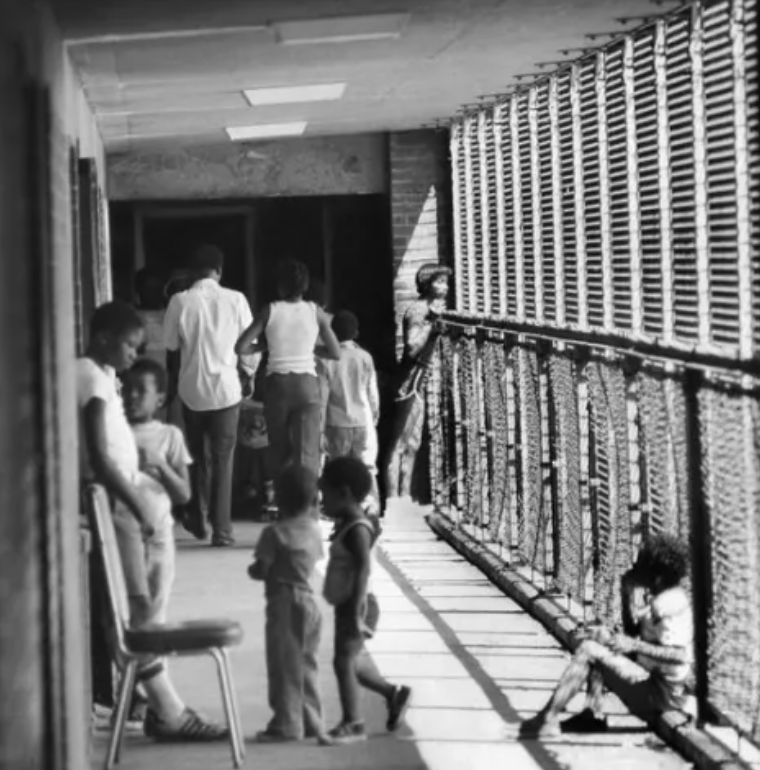
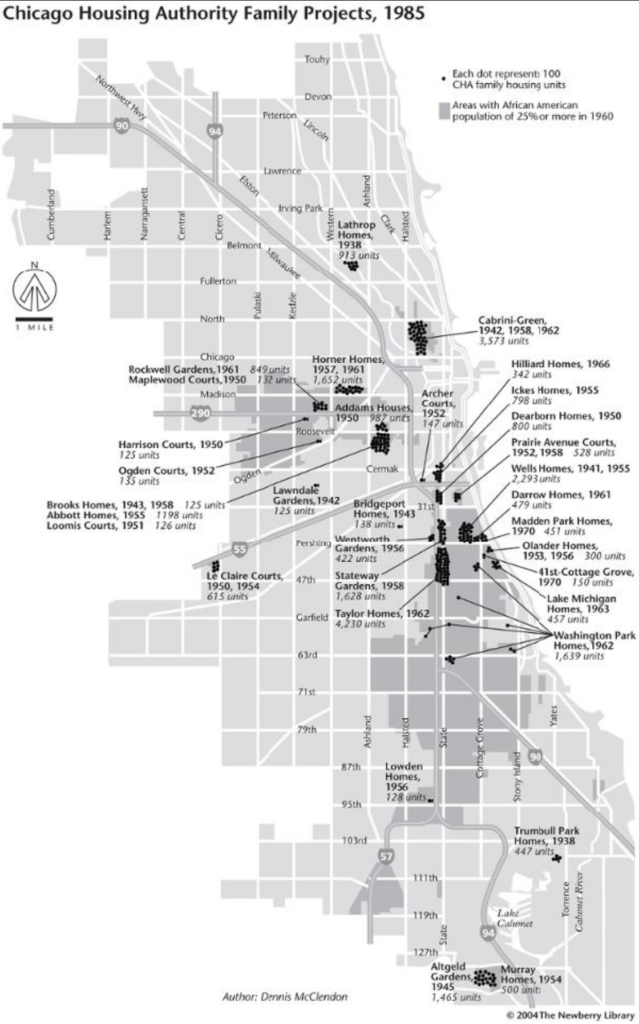
After decades of bourgeois dictatorship enforced by CHA, cemented by the lumpenproletariat’s inability to abolish itself, and the continued racialization of public housing, CHA’s authority was snapped up by the federal Housing and Urban Development (HUD) in 1995 on charges of corruption.10 Just four years later, and Chicago’s own Mayor Richard M. Daley was able to seize it back, after agreeing to clean-up CHA’s gambit and Chicago as a whole. Between CHA and HUD, what this meant essentially was the trepidation over privileges and which agency would be the one to pull the rug under thousands of inner-city proletarians. Their relationship has long been purposefully opaque as to remain unaccountable to the public it houses, and we will cut through some of the mystery and fat to ease into what can be considered the largest domino of demographic shifts in Chicago’s inner city.
To keep it concise: In the early 2000s, the city’s largest landlord, CHA, demolished roughly 25,000 units of inner-city public housing, and sought to integrate these tenants into “mixed-income developments” where proletarians blended in with petit-bourgeois and upper semi-proletarians (Vecchio, 2022). This was not much more than lip service to undergo demolition in valuable land grabs and speculation hikes. Even as late as 2017, only 8% of former residents had landed in the mythically described “mixed-income developments”, whereas over 33% of those tenants were left without any assistance at all, another 12% were evicted, and yet another 10% had died; When all was said and done, far more residents died than were housed in the CHA-HUD scheme. The remaining residents were carved up between still-standing housing complexes-typically on the South Side and the outskirts of the city-as well as the private market.11 Not only were thousands immediately cleared from critical locations in the urban core, but in the span of several decades since, new high-income developments have driven most remaining residents without a voucher (Crawford et al., 2021).
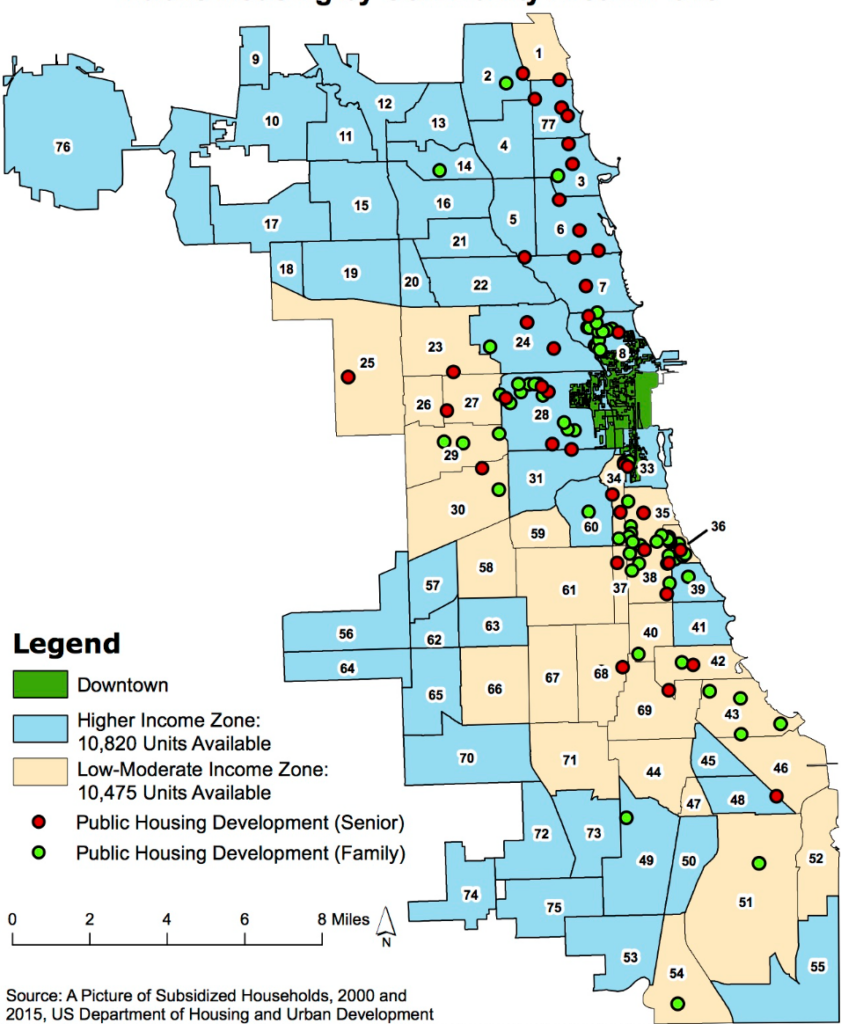
Outside of points of production and sprawling public housing, the character of the urban proletariat’s settlement has also been defined by its tendency toward White supremacist violence. Much has been said about this topic and especially in Chicago, but it is important to portray this history as one that extends beyond the construction of public housing. Since the Great Migration of the early 20th century, the most considerable proletarian experience in Chicago has been defined by its Black population: It attracted 500,000 migrants during this period, resulting in a Black population that peaked at 33% of the city’s census by 1970.13 Through capitalist domination, Cold War scares and the like, many a neighborhood had been completely turned over and disheveled before it ceded entry to Black workers. Unlike what its name may suggest, Red Summer of 1919 was not a great proletarian assault on capital, but rather a drowning of a Black man, followed by a week of bloodshed initiated by White-especially Irish-gangs.14 While having left a poignant mark in local history, it was by no means unique. The entirety of the city’s 20th century had been defined by White sectarian violence under the guise of “neighborhood defense”, where middle class Whites-and oftentimes allied Latinos, as in the case of the historic Back of the Yards neighborhood-fought low-level wars to keep Black proletarians out of their urban oasis. Once it was clear they could no longer hold their petit-bourgeois fort, the White coalitions fled with their capital, leaving a dilapidated, redlined mess in their wake: Notable “inner-city” examples include Fuller Park, Back of the Yards (south of 51st Street), Englewood, West Englewood, and the previous national headquarters of National Socialist Party of America, Marquette Park. All experienced population exodus and subsequent crises in the quality of housing. Generally as the century progressed and the 20th turned 21st, most of these relatively affluent White populations fought and fled-with the exception of inner-city White outposts such as Bridgeport, northern tracts of Back of the Yards, and Canaryville. For these precious few, sectarian violence on Blacks have carried their legacies through the 1990s (See the 97’ beating of 13 year-old child Lenard Clark by 3 White men, putting Clark in a coma) leaving lasting segregation and informal bans on Black homeownership in these areas up to the early 2010s.15 As seen in the map above then, most proletarian communities in the city have been characterized both by Blackness and an arm’s distance from the exceedingly luxurious inner-city core.
As for the rest of the urban core’s working class during this time? Most genuine inner-city neighborhoods have steadily shifted in the last 50 years, highlighting a decline in low and middle-income residencies, as well as increases in housing costs displacing proletarians further from the urban core. A comprehensive study between 2000-2017 demonstrated a collective 42% of neighborhoods-almost exclusively settled in the urban core-saw a rapid increase in housing costs, defined as being several degrees above the regional median increase and in relation to wages. The same study revealed 59% of middle-to-high income neighborhoods posed an existential threat of displacement to its remaining low-income households, where 33% (or 400,000) of Chicago’s proletarian and semi-proletarian households lived. Furthermore, regarding neighborhoods which were most hemorrhaging their low-income households to the south/western suburbs during the same period, 62% happened to be middle-to-high income areas.16 This trend can also be illustrated in the rapid turnover of 2024, where 40% of all SROs-single room, low-income dormitory housing which primarily accumulated in wealthier neighborhoods-were found to have transformed into market rate or luxury residences over the last decade.17
All across the urban core, displacement has for the most part tilted counterclockwise: Skyrocketing rents in Northern neighborhoods along the Lake, spreading west to the complete gentrification of the Polish immigrant corridor along Milwaukee Avenue, now pushing out further to Puerto Rican workers in West Humboldt Park and the city limits as well. While there is much less development overall, rotating southwest we see similar patterns in Pilsen pushing toward Little Village, Chinatown through McKinley Park and Bridgeport, with university hubs in Little Italy and Hyde Park which have specialized in the removal of Black workers in the Near West Side and Southern Lakefront, respectively.
Earlier this year a study concluded that to magically accommodate some of these displaced proletarians, almost 290,000 units of affordable housing would be needed in Chicagoland.18 Unless we were to embark on some level of social housing program which was able to best even FDR’s racialist sprees, this is a historic gap which will not be broached.
With a historical city succumbing to its own contradictions and no longer to sustain its own feed, it is clear the proletarians will settle elsewhere.
Exposition on the Municipal Outskirts
It is here, no longer the inner-city, where the proletariat is choked under the most wretched of conditions, where there is little hope but to claw back up to the Earth. When we refer to the “Municipal Outskirts”, we refer to Chicago’s Far South Side, stretching from nascent, post-steel Eastern neighborhoods on the border of Lake Michigan and Indiana to the demographic container that is the 57th Expressway, intersecting with 119th street. Encompassing much of what is considered “the Hundreds”-as in streets after 100th and on-many of the neighborhoods on these municipal outskirts, from West Pullman to Riverdale, are depleted of the wide arrays of work that made them once more habitable. Of the many devastating blows to local proletarians, we can especially mourn the steady scaling back of Pullman-Standard Car Works, a massive plant which once employed 20,000 workers, before shuttering completely in 1982. U.S. Steel likewise employed 20,000 laborers before scaling back, and plants finally closed in 1992.1920 After over 50 special years of post-industrial decay most synonymous with the Rust Belt, new generations of lower semi-proletarians-proletarians without totally consistent wage labor/employment-and lumpenproletariat are being cast into the fire. As of 2024, youth jobless rates (16-19 year olds) rest between 78.7% – 85%, whereas young adult (20-24 year old) jobless rates remain high at 46% – 56% in predominantly Black Far South outskirts; Segregated Riverdale is also one of the bastions for total unemployment, posting rates between 41.5% in 2009-2013 and 29.1% in 2019-2023.2122 All aforementioned ranges are some of the highest in a city economy which is already remarkably difficult to maintain steady employment in, leading to growing reliance on haphazard social safety nets facilitated by a city that has chosen to forget its children. It’s not that the Far South Side is all doom in its entirety: These municipal outskirts simply amplify the existing class and racial supremacy seen in the rest of the city and nation. The wealth and privatized spoils of Chicago can still be encapsulated in old Pullman rowhouses, East Side bungalows, and Beverly golf course-adjacent mansions: Yet redlining and hard physical borders, such as the construction of the Expressway, have done with the rest, locking much of the proletariat in a containment zone and exacerbating unemployment. Of course, much of these conditions are specifically and purposefully isolated to Black proletarian strongholds, until over the years they slide into dour states of semi-proletarian relations.
Exploring Proletarian Death in the Outskirts
The old contradiction between wage labor and Capital is not dead: It has merely decayed on its own accord in the banlieues of the municipal outskirts, surfacing as a contradiction between complete liquidation and Capital. As lower semi-proletarians, many of these residents-and especially young families, where unemployment and fragile employment is often highest-there is less so a struggle between bad labor and big bosses. It can be said that the dominant struggles in the proletarian settlements are both the terror and broad support of Capital in its aims, and a general indifference towards its State forces who act methodically. Let us elaborate.
In his office, Alderman Anthony Beale of Chicago’s 9th Ward (About 45,000 residents in segregated Black neighborhoods Chatham, Roseland, Pullman, Washington Heights, West Pullman, and Riverdale) has a wall-no, mosaic-full of pictures with himself and various developers, ear tagging whatever abstract amount of profit each business makes as direct sums of “community investment”. His office is full of evidence of various community projects, including vain attempts at presiding over gun violence protests and the like. While he is supportive of terroristic measures of the Chicago Police Department as well as ICE raids, the primary function of his office is as an employment center: Stacks and stacks of pamphlets are piled on several tables, and lines of fliers are posted everywhere, largely consisting of mutual aid programs and job fairs in the Ward. Despite such a seemingly watchful eye for the community, he is never at work, and his office is hostile to most residents who intend to pay him a visit. When pressed for comment in support of local working class professional organizations, he is even more elusive, only appearing at pageant-like monthly town halls which are stacked with his own invited support groups, as well as local Church hierarchy, business owners, and elderly community watch groups. We ourselves attempted to make a visit several times and get his thoughts on local sociology, but he subsequently called the police on us and cancelled public appearances for the rest of the year. The mystery and curiosity is resemblant both in the local public’s apathetic and even derisive attitudes toward him, including absurdly low political turnout which has fueled his 26 year reign in power as 9th Ward Alderman, and his choice of mass-political language.
Beale is a textbook neoliberal, who has generally supported gutting any and every safety net and public service in favor of providing tax incentives to multinational capitalist enterprises. In charge of “opening up” Black proletarian/semi-proletarian strongholds such as Riverdale, West Pullman, and Roseland, the Alderman hasn’t done a terrible job: He’s worked on a tax-increment financing program (TIF), which directs public slush funds toward attracting businesses along the barren commercial districts of Roseland, land development with the local Walmart, as well as various manufacturing sites costing both capitalist and working class taxpayer tens of millions to open. He is also notoriously close with real estate developers, who have been putting their ducks in a row, buying up cheap, barren plots and dilapidated buildings along what is expected to be a 5.5 mile Red Line Extension gutting through the 9th Ward.23 Under the wing of the ultimate modernizer and local serviceman, these are the alignments the capitalists are making in the near-hinterland of Chicago. It’s a patient game compared to some of the more stylish pursuits in the rest of the city, but it is still poised to be exceptionally profitable. And for the working classes here that do not commute tens of miles, this game of land speculation is naturally welcome. Any bit of modernization and social production is deemed better than the urban decay that is currently reproduced. On the horizon, this Old World awaits promises binded by fluff community agreements and ear tagged median salaries over $60,000.24
What then, is the relationship to proletarian death in a neighborhood like West Pullman, which between 1960 and 1980 was gutted of all key infrastructure, then shifted from almost 99% White to 94% Black? It seems natural, fated, that after an inter-generational wait the workers will first and foremost seek their work back. And for $60,000 a year, who can blame such a proposal from Beale? In considering the prospects of communisation in a deproletarianized community, communists have to evaluate first and foremost the contradiction of developmentalism in its entirety. The tendency toward total technical domination, in establishing a technique in a destabilized society, in restoring the dominion of Capital in its very own wastelands. So again: What is a movement against work in a community decidedly without it, and how can communists circumvent this and push against bondage? Should not our movements first resemble the demand for jobs, for progress? And if so, who better than a leader like Alderman Beale to champion our cause?
The settler-colonial Leninist in us resides to these factors, the need to “develop productive forces”, to dictate the flow of capital and resources toward public works and benefit until there is a sizable proletariat to produce a Marxist party and establish a Socialist State, or something like that. But this strain of thought, as historically emphasized through Bolshevik reign, is yet to produce anything resembling a communist society. We do not believe one can re-emphasize capital and produce communism, nor that tools of capitalism-wage labor, Statehood and value-can be utilized to liberate ourselves from these very bonds. Answers to these questions lay sandwiched between the hard modernization processes of Beale, of real estate forces and of large corporations, and the namesake of this article, Chicago’s nascent “Red Banlieues”. Social life in housing projects, which hug the touchline of Indiana and Chicago’s South suburbs, represent the clash between capital and communisation, and the question of developmentalism as a whole.
Situated next to a Metra train line and the apparition of Chicago’s Red Line Extension, the 3 building, 180 unit Indian Trails Apartments’ namesake may be the least troubling of its characteristics. For years degraded by local, then Californian developers, it has recently changed hands between ownership firms which reside on the West Coast. In spite of its convenient location, it’s still an incredibly neglected commodity. Its lawns are strewn with trash and debris. The front doors are always unlocked and ajar, occasionally riddled with bullet holes or completely shattered. Urine and feces regularly coat the complex’s steps and elevators. The apartments routinely lack hot water and are infested with rodents and roaches, while appliances are as dated as they are defective. 2 of the 3 building’s central heating system capitulates every winter, leaving tenants and elderly to the elements. In the last years, several apartments had set on fire or exploded, with several more dangerous units resulting in tenant-led lawsuits and payouts of thousands. It has always been vulnerable to crime on residents and non-residents alike, with an offline security system leading to high profile murders on an annual basis, including a double homicide last February.25 Drug dealers frequent its outside corners as well as its hallways, and vicious cycles of neglect have left many residents’ calls to the police unfounded. It is only when management attempts to settle its disputes with the tenants’ union that CPD cruisers pile up outside the front lawn. While theoretically faced with choices of communisation, modernization or dilapidation, its residents have only ever been able to opt for the latter choices. Regarding the first of the two, in the last half year the tenant union won a memorandum of understanding with the city of Chicago, which would see the city supply new slumlord owners with roughly $50 million to finance Indian Trails’ rehabilitation. Likewise, from ownership tenants won tens of thousands of dollars in back rent voided, which management had falsely calculated to threaten eviction. Where mice once festered under broken cabinets, new stainless steel appliances now take their place amidst landmark conditions upgrades, a remarkable feat for a building on the literal margins of Chicago’s municipality. On the dilapidation front, those that refused to stick it out were placed in other similarly dour conditions across the city, or moved altogether to nearby Northwest Indiana.
What Indian Trails reinforces to us is not that everyday, working class people aren’t capable of great reforms, but rather that great reforms are both the organ and product by which working class people continue a slavish existence. Beale himself was revealed to be a secret proponent of the rehabilitation project, because it promised to “clean up” the area by making Indian Trails a more desirable place to live. The rehab project would seek to put Indian Trails at a status requiring several years of waiting for a family to hope to land a spot in, filtering out lumpenproletariat and the like. Amidst shiny new things, devilish management teams, the foot soldiers of contential capital in this case, brand leaders as criminals and physically and psychologically torture those tenants who most spoke out for the movement; Families are generationally sandwiched between homelessness or eternal angst and the future dilapidation at these buildings. Property rights are manifested not just in city code but in continuous tenant demands which only emphasize their tie to the land. Likewise, workers in these municipal outskirts demand more work, and so on and so forth until they too are priced out of the near-hinterland city outskirts. Sometimes a movement is not a movement at all, but a regressive pattern organized along the same lines as previous strife.
The functional difference between these reactions and others around the city, remains that Indian Trails and its wider West Pullman community is precisely at the point where developmental speculation and the suburbanization of the proletariat meet. While plans to reignite local economies rely on the aforementioned billion dollar transit bill and empty lots are slowly but surely bought up, waves of Latinos, struggling artists and gays will continue embark on the first waves of proletarian displacement throughout the neighborhood and Beale’s 9th Ward: A look into the historical community of nearby Black laboring stronghold Pullman, which has skyrocketed to 13.4% White and 7.7% Latino as of 2023, is all you need to know about what the city envisions for the Ward: The replacement of workers by racial caste, until only petit-bourgeois and upper semi-proletarian couples can scrap together enough for a 1-bedroom apartment.26 While artisan coffee shops continue to sprout along Pullman’s cleaned-up 111th Street, the charm of West Pullman’s bungalow belt is sure to suffer a similar fate. Once the organized lumpenproletariat is cleared out, of course, which we will consider in greater detail in the following section. Yet in spite of everything just mentioned, geographically there is little elsewhere for the local proletariat to go in the State of Illinois. Furthermore, they had already been displaced and settled in the Ward through the middle-late 20th century. All of this pressure makes West Pullman historically unique, in that its path to communisation could represent the undoing of entire regional service, logistical and remaining light manufacturing sectors.
Communisation can be viewed through the organizing campaign at Indian Trails, where waves of short bursts of energy slowly pressed the ownership and city’s hand. Exasperated tenants began grouping together for the most bread and butter of demands, reporting their issues and fighting to patch the most temporary of holes. Initial blows at management came not from the complex’s most impoverished or isolated tenants, but from those with social and familial structures within the residence and nearby schools; Those who wielded the most communal resources at their fingertips rose to the fore, before being struck and another connected leader took their place. This almost formulaic example has repeated itself dozens and dozens of times by different cells of activity, until total activity within the union was largely not from tenants with temporary, ongoing issues at all but people who identified abolition as a real target. They had evolved both in methodology and in seeking the damaging of managerial power structure.
So in abolishing the family, we can proclaim communisation is… family? Blood-soil relations? Not exactly, but these ties are a critical component of the pre-existing social companionships in the municipal outskirts. Much of wage labor here is atomized to the individual, and that which is collective i.e. homecare corporations, Amazon warehouses, and retail/maintenance positions are divided up by SEIU and the industrial giants to grovel for eternity. Where the rest of the city management has left social categories to rot, these pressures have only solidified notions of solidarity into something that is effervescent and volatile, ready to burst at a moment’s glance. Due to the nature of this resistance, the familial grouplets can only achieve as much if they can consider the bonds within their own cell: How do those with communal relationships, leases and infrastructure interact with those who are entirely dispossessed? How is the individual eliminated, and how is the tenant/community member/worker’s identity abolished as class? Though almost none have reached this breaking point, the sheer concentration of cells and their ability to reimagine power structures make for a promising outlook. Tactically and for survival, they already show the natural tendency of struggle outside of work and outside of capital, using their mutual and local relationships to provide “life house” style safety nets which typically circulate outside of capital. These relations are naturally defensive, but they emphasize the possibility of an entire community, city, and world’s ability to circulate the provision of needs without capital.
On the other side of the developmental coin, however, is the existence of the organized lumpenproletariat. In the remaining sections, we discuss the existence of such and their dwindling claims on proletarian strongholds, before residing briefly with what’s left of proletarian suburbanism on Chicago’s South Side.
Dilemma of the Lumpenproletariat
In or outside of Indian Trails, the lumpenproletariat is not a revolutionary class. Despite celebrated attempts at prison organizing by those like the Black Panthers, the organized lumpenproletariat in these communities represent a symptomatic and harmful social strain, a controlled opposition through which police and Feds build entrenched hegemony. As its basis specifically tends toward accumulation-of capital, in the forms of money, land, and territory-we can consider the organized lumpenproletariat, specifically gangs, as rudimentary lumpencapitalist endeavors. The primary contradiction is of course capital, and these organizations, in lieu of proletarianization, have sought to generally maintain the transfer of money and land not dissimilar to those private equity speculators working with Beale. What cements the fate of the working class here is the squeeze between developmentalism and neoliberal prosperity, and the pre-existing alternatives to a form of accumulation which no doubt excludes them.
The Black lumpencapitalist endeavors, which are the strongest on the South Side, sometimes receive special treatment from communists, as well as wealthier social democrats. We would identify this as a flavor of multipolarism, where hopeful wishes placed on the Black masses abstractly group competing class interests together in the name of anti-hegemonic attitudes, such as the State, white supremacy, and so on. With such a terroristic regime in CPD, it is hard not to show some sympathy. Supporters of this thought process will point to brief struggles after the murder of George Floyd, where some Black lumpencapitalist groups displayed some “anti-hegemonic” or anti-formist attitudes, partook in the looting of several businesses across the city, and engaged in conflict with Latino gangs in attempts to rob the petit-bourgeoisie in the latter’s territory.27 Whereas formerly White and now Latino gang territory consisted of land defense and therefore the defense of capitalist classes, Black lumpen-for a moment-showed an intolerance of this divide. But this view is both doomed and void of analysis of the relations which historically fuel lumpen activity, and mistake our liberation for simple grabs at power. Or rather, modern lumpenproletariat organization remains committed to the circulation of capital, and contradictions and struggles between capitalist agencies cause these brief ruptures in the order of things. Of course no matter which force claims victory, social relations continue to reproduce capitalist ones.
To look at a specific example, let us consider one of Chicago’s most infamous lumpencapitalist exploits, the Gangster Disciples. The GDs, who now are alleged to operate in over half of all US states since their conception in the 1960s, still maintain territory over a large breadth of the South Side of Chicago.28 Stretching to the municipal outskirts, this lumpencapitalist organization is a curious one, for it provides several occurrences: For one, it is a significant bulwark against Capital and its modernizers where it establishes territory. Thus its extension into daily life keeps property values and rents low, allows proletarians and lower-semi proletarians to continue to inhabit these neighborhoods, if not at the price of more frequent violence and lumpen terror. But just as capitalist organization cannot help but chew off its own hand, the lumpencapitalist organization is also a cannibalist and masochistic affair. In the wake of segregation and redlining, remaining social reproduction has been swallowed up by organizations like the Gangster Disciples. For all of its work in ironic community retention, scaring off gentrifiers and real estate agents, the GDs cannot reverse the wave of depopulation of the South Side of Chicago, where redlined neighborhoods south of 51st Street, and especially the Far South Side, are half-barren or dilapidated. Hundreds of thousands had already left to the suburbs and American South, and after the adventures of former Mayor Rahm Emanuel in the early 2010s, building density in the proletarian communities of the South Side was severely depleted. The City of Chicago managed to bulldoze hundreds of properties a year, helping make inroads for private investment and delivering a blow to organized lumpen.29 Through dilapidation and ghost blocks become speculation, and either way the message is clear: Lumpen operations will swallow less of the social life, and their “hold” on blocks will become less relevant to its social reproduction (See: White gangs in Chicago’s Canaryville, McKinley Park, Bridgeport, all neighborhoods which developed beyond White gang activity. Looking at you, Irish Lords!). As such it is a suicidal organization at least in this municipality, doomed to capitulate to Capital eventually, for the population it recruits will never recover, only be replaced by the stereotypical envoys of gentrification and displacement. In the next generation or two, this form of lumpencapitalism in Chicago is doomed.
If only we had so much time to wait. The lumpen operations, especially as speculation and infrastructure projects expand, will likely continue to be less viable long term prospects. The crux of the matter is immediate needs of the local proletariat to overwhelm bourgeois rule before they too are displaced. We can only say it is inconclusive, hence the dilemma. The State, with such immortal power and police budgets could easily crush the lumpen organizations, and so a symbiotic relationship continues to keep the proletariat sliced open. Social needs are still filled by the lumpen enterprises, and they will continue to exploit this opening until their social pool is completely depleted; Like the capitalist scheme, the lumpen cannot acknowledge its own fleeting existence. Thus the proletariat itself is trampled between the two, and as the city makes efforts to clean up for developers, it would be foolish to assume some middle ground: Development may very well do with the lumpen and proletariat in one swoop.
In immediacy, gaps emerge in suburban municipal outskirts that Capital, law enforcement, and gang affiliation have failed to settle and control. Gangs are less successful in “block by block” categorization in these areas, police are slow to respond to almost any occurrence supplemented by the sheer amount of ground they need to travel, and Capital is still years out from total subsumption. With value-form falling behind to other forms of social currency, the municipal outskirts have vital organs to reproduce structures against and without value. The limits? Simply the proletarian’s imagination. Whatever is possible under communism is possible here, on the margins of Chicago’s urban and suburban society.
Suburban & Semi-Proletarian Crisis
Between 2000-2012, poverty rates had grown twice as fast in suburbs than cities across America; In the Chicago metropolitan area, the share of the region’s poor categorized as suburban has risen from 34 to 50% between 2000-2016.3031 Whereas the municipal outskirts largely give birth to menial day rates, delivery-gig sector employment, or unemployment altogether, some of the near suburbs tell a different story. If development is the gravedigger in the urban-and even outskirt-proletarian community, then the South suburbs of Chicago are its ghastly reincarnation into even more immiserating life.
Groupings within the diverse “Southland”, or rough grouping or suburban municipalities and agencies south of Chicago’s outskirts, have long been plagued by some of the same issues faced by the Far South Side: Redlining, disinvestment, and so on.32 Quaint White and petit-bourgeois outposts situate themselves with hard borders to collapsed Black ones. Yet in contrast to Chicago, Southland’s concoction of economic drought manages to drive the blade further; Some rates of poverty in Southland (40.8% in the Ford Heights municipality) manage to triple Cook County’s average (13.3%) and nearly quadruple the Chicago metropolitan area (11.0%); Other towns such as Dixmoor, (27.9%), Harvey (25.2%), Chicago Heights (24.7%), and South Chicago Heights (23.3%) follow suit with regional highs of poverty.33 What unites most of Southland is a sheer lack of tax revenue to fund basic public functions, fostering reliance on a dwindling pool of homeowners to cover the deficit. The decapitation of local revenue can best be illustrated by Walmart’s property taxes in Southland’s Richton Park, the tune of $2,000,000 per year, compared to its $450,000 dues in exceedingly hipster Pullman, Chicago (Roeder, 2019). Thus, fewer employers actually look to Southland for economic incentive, even compared to Chicago’s near-hinterland. If the question of how to liberate ourselves from work becomes stymied by the desire for work’s sustenance in the municipal outskirts, these suburbs present something else entirely, yet equally as existential for the communist.
An intimate relationship between Southland’s proletarian communities and the municipal outskirts has and continues to hold special fruits. Many residents of two of the largest public housing complexes in the region, Altgeld Gardens and Indian Trails, are originally from Southland, moving further north into Chicago for work or to make use of their public housing voucher; Almost half of active Indian Trails tenant union membership has at least some sort of familial relation to Southland, seeking the cradle Chicago’s Far South Side as an economic refuge. This, of course, places even greater stress on the suburban proletarian community, where unemployment and semi-unemployment hikes with the labor market, the cost of living, and the cost of remaining a resident in these heavily taxed areas.
We are interested in two questions here, both that of bourgeois policy for Southland and methods in which working people here can liberate themselves. Regarding practical applications of where the suburbs are headed, it remains to be seen if there is any direction at all. A notable case is that of Harvey, Illinois, a sizable city of just under 20,000 and one of the nearest components of the suburban crisis to Chicago’s city limits. Harvey has a larger tax base than most of Southland, but still has the 3rd highest property taxes in Cook County at 52%, and as it has done in past decades, its city government has continued to spend more money than it earns into 2026.34 Yet as cities in Illinois cannot declare bankruptcy, Harvey’s city council petitioned to be declared financially distressed in late 2025, before being shot down, essentially meaning that the State of Illinois will not be recognizing nor providing breaks for the tax crisis. Why does this crisis matter at all? Because in lieu of serious neoliberal economic investment, the city will continue to hemorrhage its own, creating economic refugees to Chicago or further south (Wall, 2026). Just last August, for example, Harvey laid off 10% of its entire municipal workforce, most of which will have to relocate to different cities to meet their experience and skill repertoire.35 The harrowing tax rates further chip away at this base, jobs will not be regained, and new proletarian colonies will emerge elsewhere.
And it is still unclear whether the same “life-house” style organizing will be effective in a region characterized by flight from it, where resources are incredibly scarce. The extent that said methods can be utilized in a revolutionary situation is also debatable, as shown by the limits in West Pullman residents’ ongoing struggles. But due to the sheer weakness of cities within Southland to enforce law and the complete decimation of the petit-bourgeoisie, there is a tremendous power vacuum, one that will likely be seized by either the proletariat or the lumpenproletariat within our lifetimes. The task for communists is to identify allies in these areas, and explore the implementation of various approaches while understanding that capital as a relation cannot be avoided or danced around.
Proletarian suburbanization is not just the enrichment of the inner city, but it is also the battleground of the hinterland, where both capital and labor are missing inputs for a positive social reproduction. Severed from production processes and without the levels of concentration of even municipal outskirts, the endless stream of individuals are the last social product. What’s left are townships and cities on suicidal notice, and in Illinois, there will be no Federal or State angels to claw out its corpse from an early grave. With infrastructure projects looming on the Far South Side, Southland’s proletariat ponders its existence and fate.
Conclusion
We are not mystics, so we cannot predict the site of the next great uprising. Likewise, we cannot say if Southland’s outposts will die, where those proletarian strongholds will go, or what pinch of Lassalle might enrich the nightmare. Our job is merely to monitor and assess these social antagonisms, poking at them as they may, to expose those contradictions in their entirety. In this role, we cannot overemphasize how important it is to chart these demographic shifts. Where the lower classes settle will be decisive in how future struggle plays out, and it is the image of the inner city steel worker we must clear from our head. The near hinterlands in Chicago and across the Rust Belt are aching, bleeding with existential dread that can only be subsumed by an entirely new possibility. As much as development has made gains, it is also exceptionally weak here in enforcing its own ambitions. The existence of organic proletarian organization, and its ability to rethink itself in an entirely social way points to overcoming its own categorization.
References
- Crawford, K., Diamond, R., & Moretti, E. (2021, December 8). Expensive “Superstar” Cities Are Squeezing Out Many Americans. Stanford Graduate School of Business.
- Narefsky, B. (2014, March 10). The Suburbanization of the US Working Class. Jacobin.
- Binford, H. C. (2004). Tenements. Encyclopedia of Chicago.
- Garb, M. (2003, September). Health, Morality, and Housing: The “Tenement Problem” in Chicago. American Journal of Public Health.
- Hunter, Robert. (1901). Tenement Conditions in Chicago. City Homes Association.
- Ryerson & Burnham Library Exhibitions. Resource Details | The Art Institute of Chicago. (2010, September).
- Choldin, H. M. (2004). Chicago Housing Authority. Chicago Encyclopedia.
- Vecchio, G. D. (2022, February 25). The Chicago Housing Authority Explained. South Side Weekly.
- Chicago Tribune. (1991, December 19). CHA Guard Shot in Robert Taylor Homes Dispute.
- Kapur, S., Bittle, J., & Mithani, J. (2021, November 17). Redeveloping the State Street Corridor. South Side Weekly.
- Moore, N. (2017, March 24). Taking Stock of Chicago’s Longstanding Plan to Transform Public Housing. WBEZ.
- Voorhees Center. (2016, February 17). Transformed? Public Housing in Chicago 2000-2015. The Voorhees Center for Neighborhood & Community Improvement.
- Grossman, J. (2005). Great Migration. Encyclopedia of Chicago.
- Jones, J. L. (2019, July 6). The Red Summer of 1919. Chicago History Museum.
- Cable News Network. (1998, October 19). Men avoid prison with guilty pleas in Chicago racial beating. CNN. ’
- Chapple, K., & Thomas, T., and Zuk, M. (2021). Chicago – Gentrification and Displacement. Urban Displacement Project website. Berkeley, CA: Urban Displacement Project.
- Fulgham, R., & Hoereth, J. K. (2024b, November 30). Where Have They Gone? Examining the Success of Chicago’s SRO Preservation Ordinance.
- Report Finds Deficit of Rental Units for Extremely Low-Income Renters in Illinois. Housing Action Illinois. (2026).
- Wilson, M. R. (2004). Pullman Inc. Dictionary of Leading Chicago Businesses (1820-2000).
- Hoekstra, D. (2025, April 30). Though the steel mills are long gone, the southeast side of Chicago still manifests a relentless spirit. Newcity.
- Wilson, M. D. (2026, February). A Normalized Crisis: Youth/Young Adult Joblessness Data Brief 2026. A Normalized Crisis: Youth/Young Adult Joblessness Data Brief 2026 | Great Cities Institute | University of Illinois Chicago.
- State of Illinois. (2025, July). Riverdale Community Data Snapshot Municipality Series August 2025 Release 1. CMAP.
- CTA. (n.d.). CTA Red Line Extension Project – CTA. Transit Chicago.
- 9th Ward Alderman Anthony A. Beale: Key Issues. 9th Ward Alderman. (n.d.).
- 2 Killed in West Pullman Shooting, Chicago Police Say. ABC7 Chicago. (2025, February 12).
- Chicago Metropolitan Agency for Planning. (2025, July). CMAP Community Data Snapshot | Pullman.
- Placko, D. (2020, June 4). Unity March Held in Little Village Following Clash Between Gangs. FOX 32 Chicago.
- 2022 Gang Boundaries. CLEARMAP. (2022).
- Mayor Rahm Emanuel’s Program to Fast-Track Demolition of Vacant Buildings in High-Crime Police Districts in full force. City of Chicago :: Mayor Rahm Emanuel’s Program to Fast-Track Demolition of Vacant Buildings in High-Crime Police Districts in Full Force. (2016, March 25).
- Dews, F. (2014, June 11). The Rapid Rise of Suburban Poverty. Brookings.
- The Heartland Alliance. (2018). The 2018 Illinois Poverty Update. Social IMPACT Research Center Publications.
- Roeder, D. (2019, December 9). Development Agency Tackles Poverty, Factionalism in South Suburbs.
- DePaul University. (2024). Ford Heights – Housing Market Indicators Data Portal . Institute for Housing Studies.
- Wall, C. (2026, April 4). Illinois Denies Request for Harvey to be Declared “Financially Distressed” City. ABC7 Chicago.
- City of Harvey to Lay Off 10% of Workers Next Month. ABC7 Chicago. (2025b, July 24).